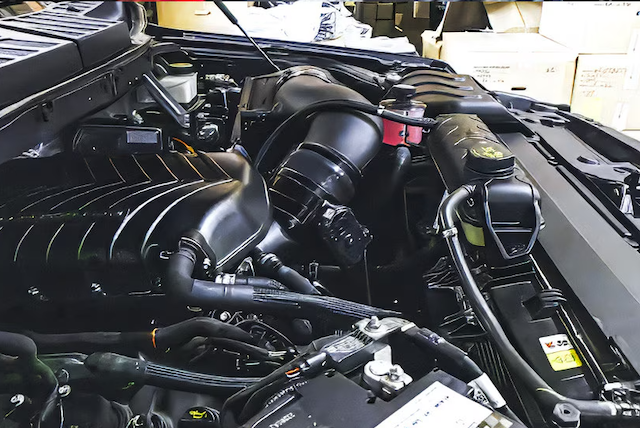
You may have noticed that the latest VMP Supercharger Kits, like the VMP Gen 6 3.0 L Supercharger kits for ’15 through current Mustang GT, all feature round throttle bodies. The VMP Apex 112 mm and 120 mm throttle bodies in both analog and digital flavors have been a fantastic addition to our lineup of performance products – so why the change?
Our engineering team took a hard look at the performance differences between round throttle bodies and the traditional oval throttle bodies when used on a positive-displacement supercharger. We’ve done the research, and the science is clear – when it comes to positive-displacement (PD) superchargers, round throttle bodies simply perform better.
We took a hard look at the actual physics and put together this technical article to share our findings. Cubic feet per minute (CFM) alone doesn’t tell the story, and this article will break down the assortment of criteria evaluated.
The Cubic Feet per Minute Myth
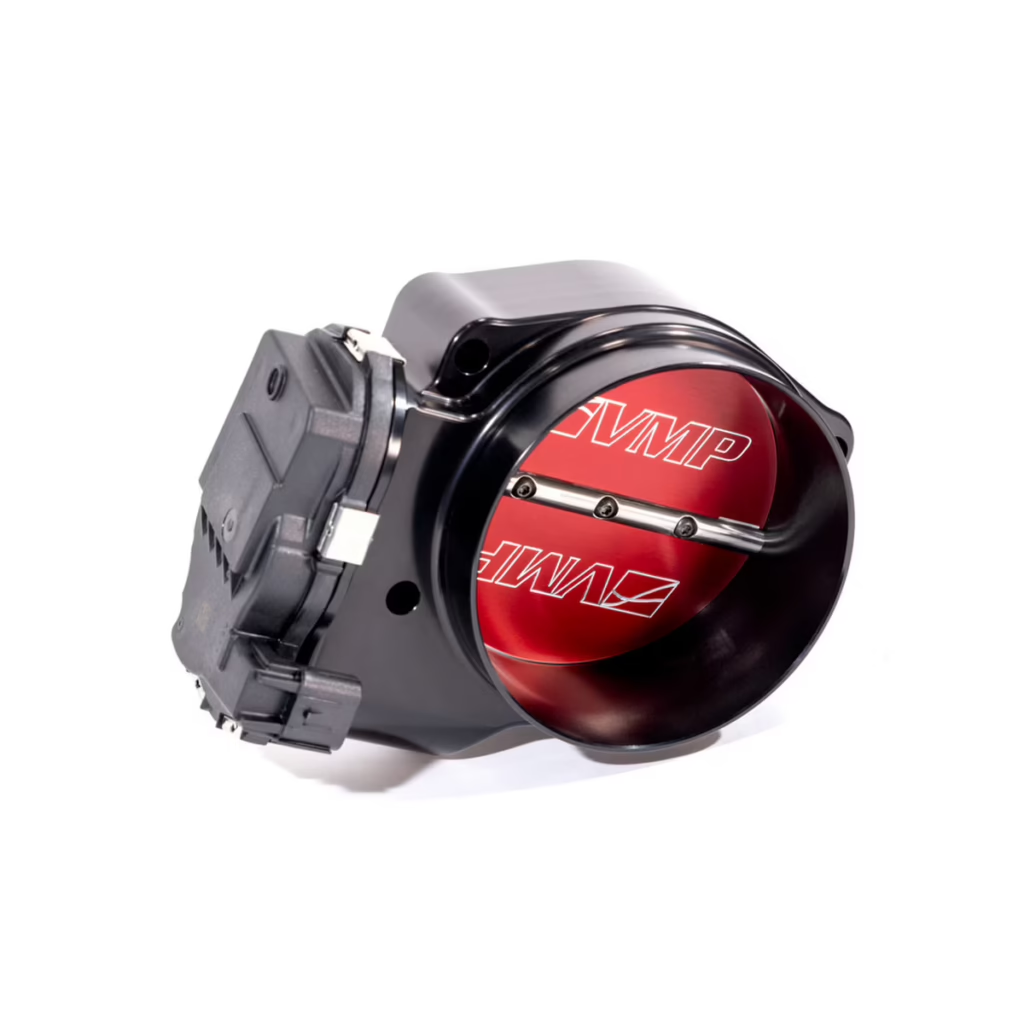
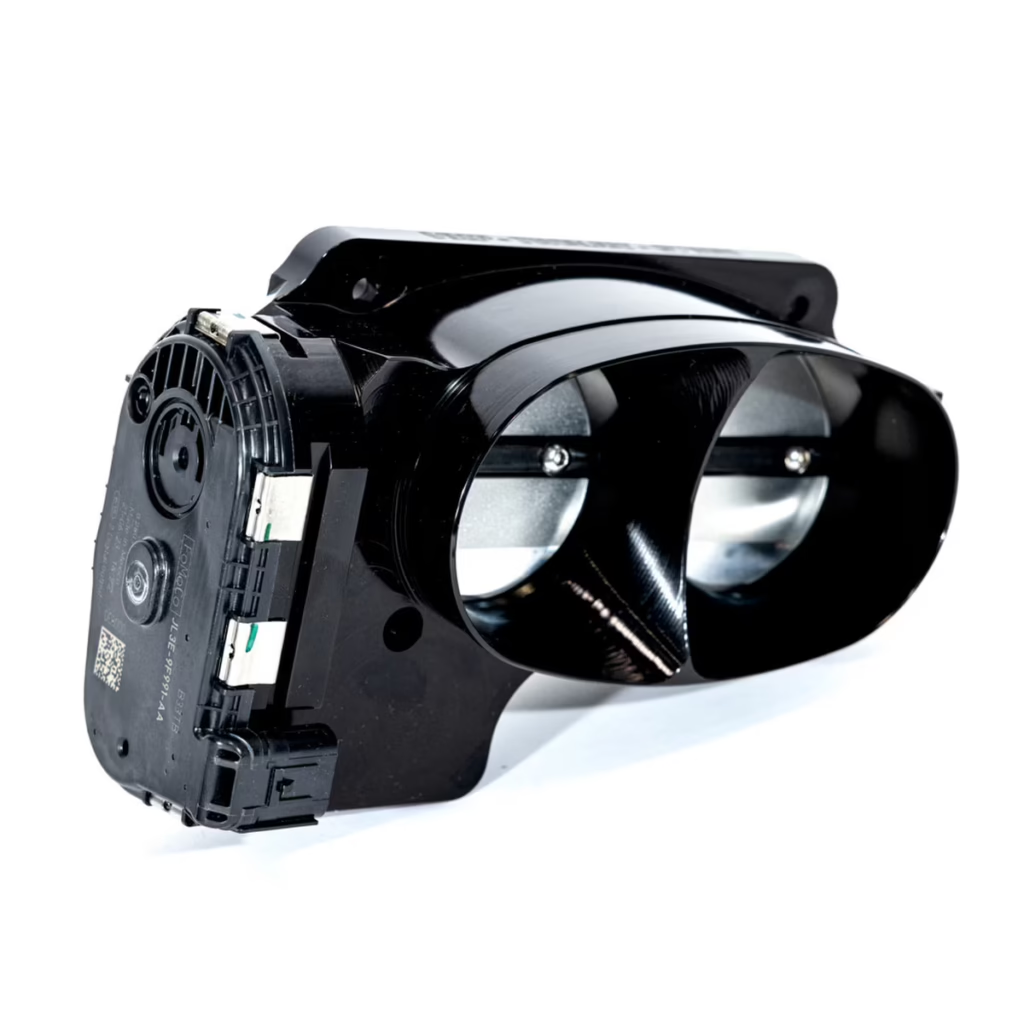
The aftermarket often compares throttle bodies using cubic feet per minute, or CFM. While CFM is a useful metric for naturally aspirated (NA) engines, it is highly misleading for PD supercharged systems. Why? In an NA engine, the inlet restriction limits how much air the engine can ingest. But a PD blower operates differently; it continues to demand its fixed displacement per revolution regardless of upstream conditions.
If your throttle body creates a restriction upstream of that blower, inlet pressure drops, and inlet air density drops with it. When this happens, the blower has to work harder to compress the air, increasing the discharge temperature and reducing overall system efficiency. CFM alone simply does not capture these parasitic effects. Instead, we have to evaluate throttle bodies using metrics that matter for forced induction:
- Effective flow area
- Discharge coefficient
- Pressure drop
- Flow uniformity
- Mass flow implications
Discharge Coefficient (Cd) and Fluid Dynamics

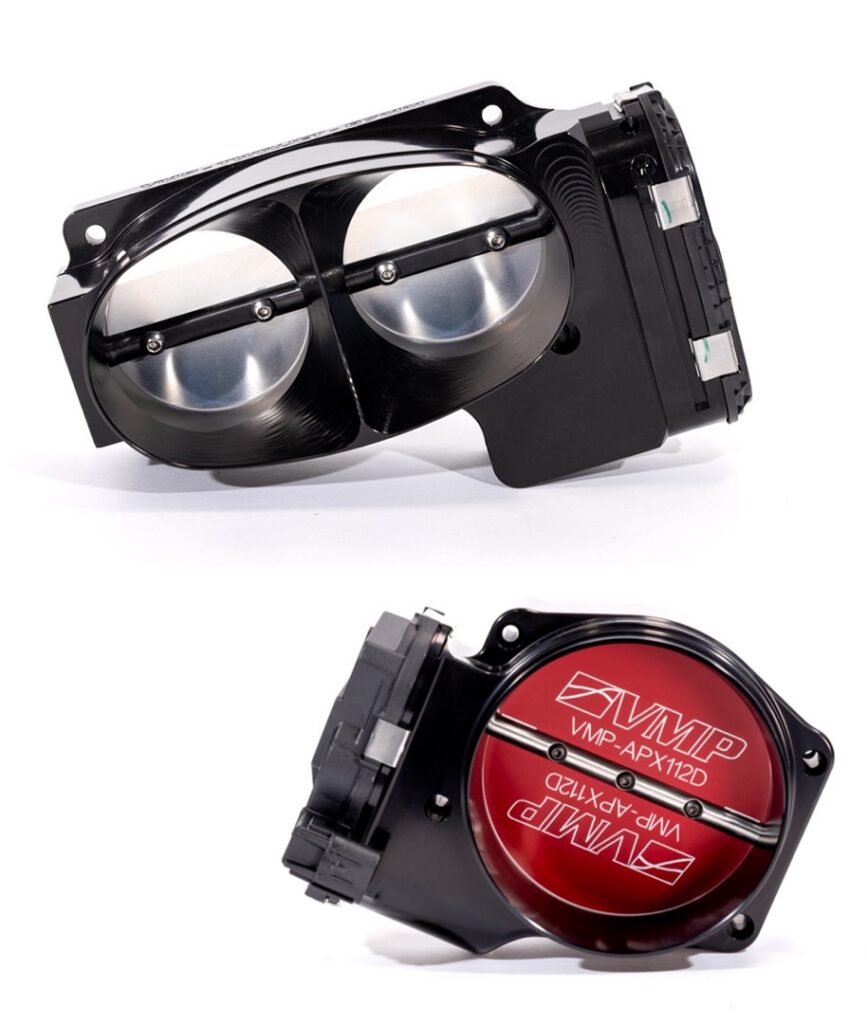
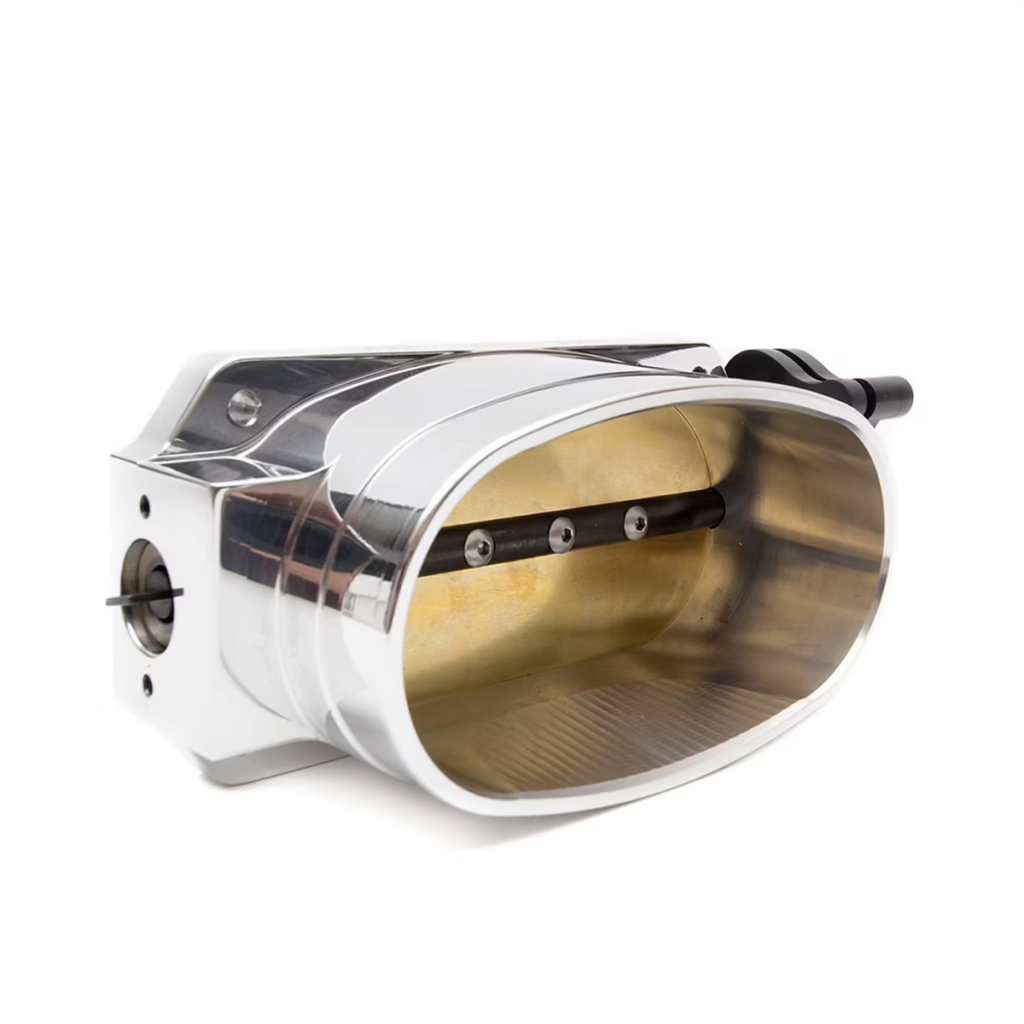
To truly understand flow, you have to look at the discharge coefficient (Cd), which measures how closely the real airflow approaches ideal (inviscid) flow. Two throttle bodies can have very similar geometric areas but perform entirely differently if their Cd values don’t match up.
- A well-designed circular throttle body typically achieves a Cd of 0.95 to 0.97.
- An oval throttle body with a central shaft generally only hits 0.88 to 0.92.
The reason for this comes down to how air behaves when it hits the ‘vena contracta’ – the point downstream of a restriction where the flow reaches its minimum cross-sectional area and maximum velocity.
- Circular designs feature uniform streamline convergence, resulting in smooth, predictable flow contraction, a larger vena contracta, and a high Cd.
- Oval designs suffer from non-axisymmetric geometry, leading to uneven flow contraction, recirculation regions, and an irregular, smaller vena contracta. Ultimately, this reduces the effective flow area.
Furthermore, oval throttle bodies create unequal airstream acceleration that leads to:
- Cross-stream pressure gradients
- Secondary flows
- Downstream vortices
This swirling motion diverts energy from axial mass flow into rotational motion. On a PD supercharged setup, swirl is entirely parasitic – the blower just has to straighten the swirling flow out, which increases pumping losses, raises discharge temperatures, and decreases the effective trapped mass.
Round designs also win the boundary layer battle. Air dragging against the inner walls of the throttle body creates friction. A circular geometry maximizes the area-to-perimeter ratio. An oval throttle body has more wall surface area for the same internal volume, resulting in a thicker boundary layer and greater flow resistance. For example:
- A 120mm circular throttle body has an area-to-perimeter ratio of approximately 30.0mm² per mm.
- A 132 x 100mm oval throttle body has an area-to-perimeter ratio of just 28.3mm² per mm.
That lower ratio on the oval means greater boundary layer influence, higher viscous dissipation, and stronger velocity gradients – all of which hurt efficiency.
The Numbers Don’t Lie
Let’s put this into perspective by comparing effective flow areas using realistic Cd values:
- A 132 mm oval throttle body offers a geometric area of 10,396 mm². Factoring in a Cd of 0.90, the effective flow area is reduced to 9,356 mm².
- A smaller 112 mm round throttle body has a geometric area of 9,852 mm². However, thanks to its 0.96 Cd, it delivers an effective area of 9,458 mm². That is a +1.1% gain in effective flow area over the larger oval!
- Stepping up to our 120 mm round throttle body nets a geometric area of 11,310 mm². With a 0.96 Cd, it produces an effective area of 10,858 mm². This results in a massive +16.1% advantage in effective flow area compared to the 132 mm oval.
Read that again. The VMP 112mm round throttle body actually flows 1.1% MORE effective air than the much larger 132mm oval, simply because the circular design is vastly more efficient at moving air without turbulence. And if you step up to our 120mm round throttle body? You’re looking at a massive 16.1% increase in effective flow area over the 132mm oval.
What Can a Round Throttle Body Do for Your Build?
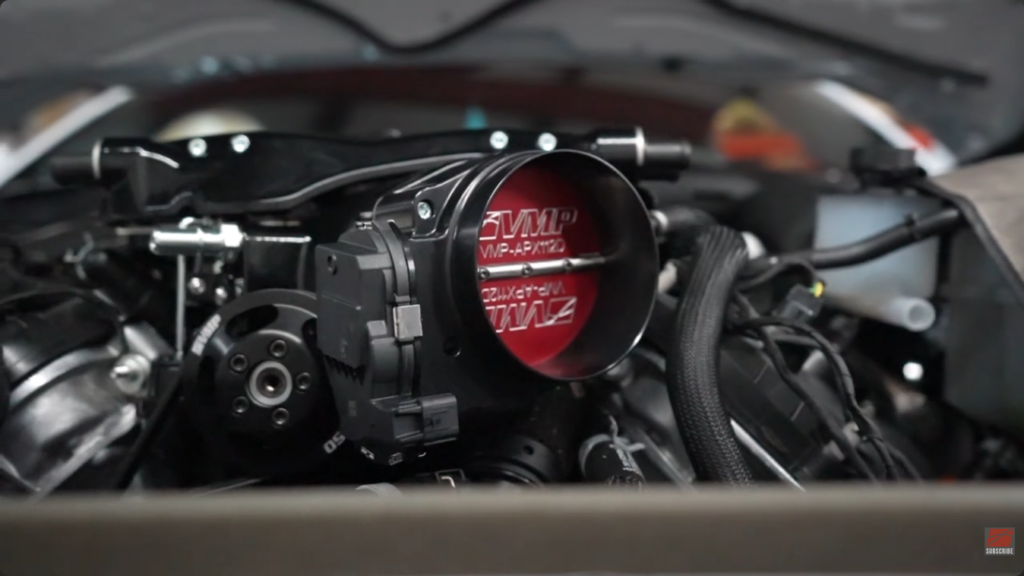

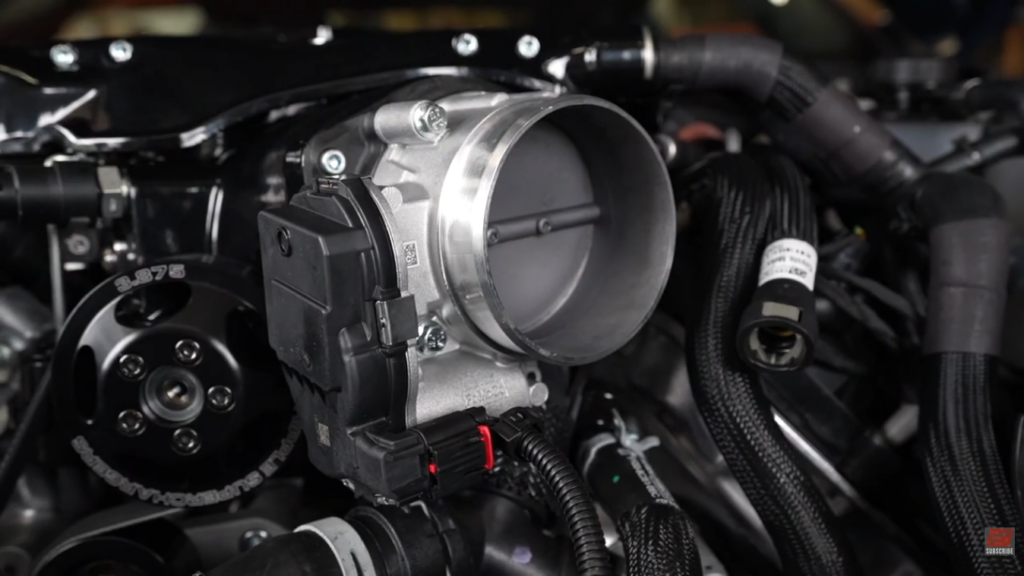
While oval throttle bodies might offer packaging advantages for certain applications, circular throttle bodies maintain smoother axisymmetric flow, maximize the area-to-perimeter ratio, and achieve a higher discharge coefficient. For a PD supercharged system, this means less parasitic pumping work, lower discharge temperatures, and much better high-RPM headroom. If you want to optimize your supercharged Coyote, drop the CFM myth and trust the fluid dynamics.
Ready to upgrade? Check out our latest line of round throttle bodies today! We believe in Real Engineering and Real Results – from design to testing and calibration, every product is engineered, track-validated, and proven by our team – you can see the whole breakdown here.
We are first and foremost enthusiasts, racers, and engineers – so we’re uniquely positioned to help you achieve your build goals. Whether you purchase from us online, give us a call for advice, or stop by our 12-acre campus in Florida for a complete start-to-finish build, we are with you every step of the way!
Sign Up For Our Newsletter
Stay up-to-date to get up-to-date information on new products, news, and VMP sales!